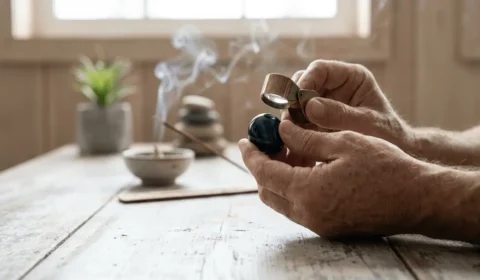



Black Obsidian, with its deep, mirror-like mystery, is a powerful stone for spiritual protection and grounding. Its popularity has made it a staple for collectors and spiritual seekers alike. However, this demand has also led to a flood of imitations, with common glass being passed off as genuine volcanic stone.
So, how can you be sure the piece you’re holding is the real deal? While purchasing from a trusted source like Buddha Bodhis is the surest way to guarantee authenticity, knowing how to identify genuine Black Obsidian yourself is a valuable skill. This guide provides three simple yet effective tests to distinguish real from fake.
✨ Test 1: Check for the “Rainbow Eye” Sheen
This is one of the most reliable indicators of genuine Black Obsidian. While the stone appears jet-black in normal light, many authentic pieces will reveal a hidden colorful sheen when exposed to a strong, direct light source like a flashlight or sunlight.
- 🌈 What to Look For: Shine a bright light on the stone’s surface and rotate it slowly. A genuine piece, especially a variety like Rainbow Obsidian, will flash subtle, concentric “eyes” or bands of green, purple, or yellow. This phenomenon is caused by the light refracting off microscopic mineral inclusions that were trapped during the lava’s rapid cooling.
- ❌ The Red Flag: Common black glass will not have this effect. Under strong light, it will remain a solid black or may show a simple white glare, but it will lack the deep, colorful sheen of an authentic stone. The Gemological Institute of America (GIA), a leading authority, notes that this play-of-color is a key characteristic of certain obsidian varieties.

✨ Test 2: The Transmitted Light Color Test
This simple test uses your phone’s flashlight to check the stone’s translucency and color. It’s particularly effective for thinner pieces of Black Obsidian.
- 🟡 What to Look For: Turn on your phone’s flashlight and place the Black Obsidian directly on top of the light source. A genuine piece of obsidian, when thin enough for light to pass through, will typically reveal a brownish, grayish, or yellowish glow. This is because, despite its black appearance, the volcanic glass is often slightly translucent and colored by minerals like iron and magnesium.
- ❌ The Red Flag: Many common glass fakes will transmit a different color, often a cool white, blue, or even green light. If you see a distinct blueish tint, it’s a strong indicator that you are holding manufactured glass, not natural volcanic obsidian.
✨ Test 3: The Surface Finish and Craftsmanship
Nature is rarely perfect, and this holds true for Black Obsidian. While it is a natural glass, its finish and the way it is worked have distinct characteristics compared to manufactured glass.
- 💎 What to Look For: Genuine Black Obsidian carvings are made by cutting, grinding, and polishing a solid piece of stone. This process, especially on intricate details, will often result in slightly softened edges and may leave behind microscopic, non-uniform tool marks or tiny pits (“sand eyes”) that are only visible under close inspection. Its luster is beautifully glassy, but it’s rarely a flawless, perfect mirror.
- ❌ The Red Flag: A fake is typically made by pouring molten glass into a mold. This results in a perfectly smooth, often ultra-glossy surface with perfectly sharp, uniform, and repeating details. It lacks the subtle character of a handcrafted piece. At Buddha Bodhis, we ensure all our carved pieces are genuinely handcrafted to preserve the stone’s natural energy.

Conclusion
Distinguishing real Black Obsidian from a convincing fake is essential for anyone who values the stone’s natural energy and beauty. By performing these three simple tests—checking for the rainbow eye, testing the transmitted light color, and inspecting the surface craftsmanship—you can make a more informed purchase.
Ultimately, the best way to ensure you are buying an authentic piece is to source it from a reputable seller who values transparency and quality. For more on the history and cultural significance of obsidian, you can explore resources like Britannica.
Frequently Asked Questions (FAQ)
1. Is Black Obsidian expensive?
No, Black Obsidian is generally a very affordable gemstone because it is relatively abundant. However, rare varieties like Rainbow or Silver Sheen Obsidian can be more valuable.
2. Does real obsidian have bubbles?
It can, but it’s not common. When bubbles (vesicles) are present in real obsidian, they are often stretched or elongated due to the flowing lava. Perfectly round bubbles are more often a sign of manufactured glass.
3. What is a conchoidal fracture?
It’s a type of break that produces a smooth, curved surface, similar to the inside of a seashell. This is a characteristic feature of amorphous materials like obsidian and flint.
4. Is Black Obsidian cold to the touch?
Yes, like most genuine crystals and stones, Black Obsidian is a poor heat conductor and should feel cool to the touch. Glass may feel slightly less cool, and plastic will feel warm or room temperature.
5. Can Black Obsidian scratch glass?
Yes. Black Obsidian has a Mohs hardness of about 5 to 5.5, which is slightly harder than most common glass (around 5). Therefore, a genuine piece should be able to put a faint scratch on a piece of glass.
6. Is Rainbow Obsidian a different stone?
No, Rainbow Obsidian is a variety of Black Obsidian that contains microscopic inclusions of magnetite nanoparticles which create the colorful sheen.
7. Why is it important to buy real Black Obsidian?
Spiritually, it is believed that only genuine, natural Black Obsidian carries the grounding and protective energies from the earth. Fakes made of glass do not possess these metaphysical properties.
8. Is Black Obsidian heavy?
It has a density similar to glass. It should feel substantial and have a decent weight for its size, unlike plastic imitations which would be very lightweight.
9. What is an “Apache Tear”?
Apache Tears are small, rounded nodules of Black Obsidian. They are a specific form of the stone and are considered genuine.
10. What is the easiest test I can do in a shop?
The light tests are the easiest and most effective. Use your phone’s flashlight to shine on the surface to look for a colorful sheen (rainbow eye) and to shine through a thinner part of the stone to check for a brownish-yellow transmitted light.